
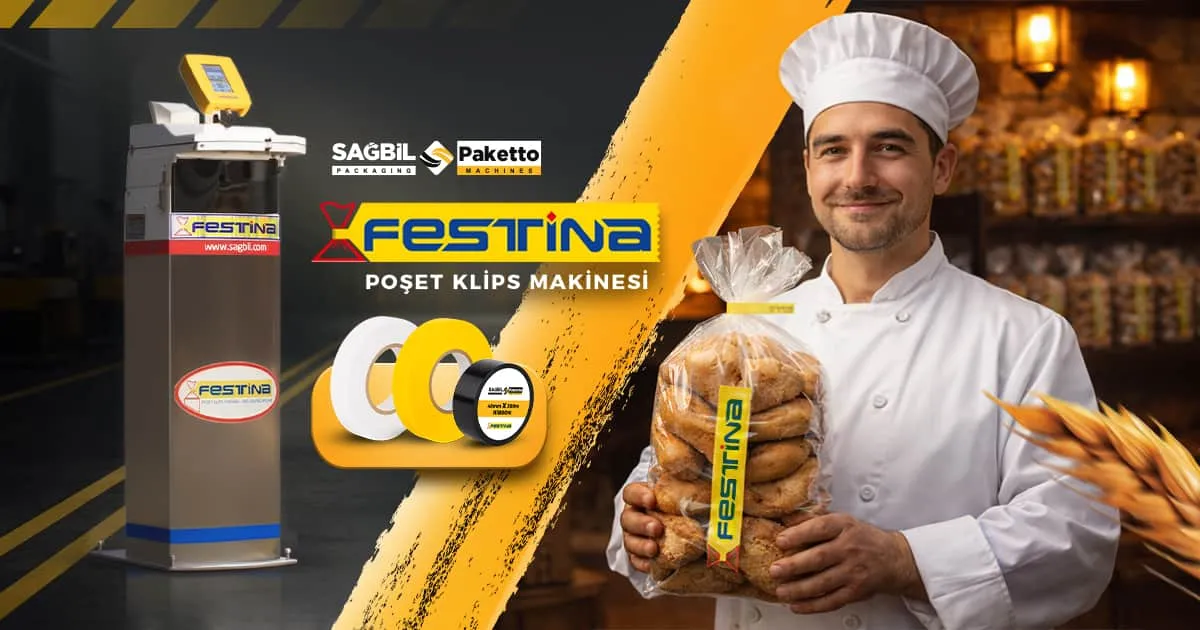
Bag Clipping Machine: Why Freshness in Bakery Packaging Is an Equipment Decision
The Clip Is Small. The Impact Is Not.
In bakery production, packaging decisions are often treated as secondary priorities. After the bread is baked and the breadsticks are produced, the closure method seems like a detail. This perspective is incorrect.
How the bag mouth is sealed directly determines shelf life, consumer experience, and food safety compliance. The wrong closure method means moisture ingress, product staling, and non-compliance with organized retail requirements. The bag clipping machine at this point is not a peripheral device — it is the final link in production quality.
At Sagbil, we bring the engineering experience from 1,000+ global projects to the bakery sector through our Festina series. This article delivers the full technical and commercial picture on bag clipping machine technology.
Bag Clipping Machine: Core Function and Technology
A bag clipping machine seals the open mouth of a packaging pouch with a plastic strip clip. The operation appears straightforward; behind it lies engineering that demands speed, print precision, and mechanical reliability across thousands of cycles per shift.
Sagbil's Festina Bag Clipping Machine performs three core functions in a single operation:
Sealing: Closes the bag mouth airtight with a robust clip. Hermetic closure is the direct mechanism for preserving first-day product freshness.
Printing: Prints critical data — production date, expiry date, price, barcode — directly onto the clip at the point of closure. Data is transferred via USB memory and supports logo and custom graphic printing.
Capacity: 15 to 30 packages per minute, covering the range from boutique bakeries to mid-scale production facilities efficiently.
The manual operating principle gives operators flexibility and allows fast adaptation to different bag sizes and product types without mechanical reconfiguration.
Bag Mouth Clipping: Which Products Require It?
The bag mouth clipping machine is most intensively used across these product categories:
Bread: Moisture loss and staling occur faster in bread than in almost any other bakery product. Clip closure enables re-closure by the consumer, improving the usage experience and directly extending shelf life after first opening.
Breadsticks and crackers: Moisture ingress destroys crispness and flavor in these products. A tight clip closure minimizes this risk at point of sale and throughout the consumption period.
Cookies and biscuits: In retail packaging, clip closure meets both practical re-use expectations and the shelf aesthetic requirements of organized retail chains.
Specialty food products: Clip closure is increasingly adopted as a practical alternative to heat sealing for specialty food packaging where consumer re-sealability adds purchase value.
Clip Selection: Standard or Writable?
Sagbil's Festina series offers two primary clip options. This choice is less a technical preference and more a commercial strategy decision.
Standard Clips — Yellow or White Strip
Clean, simple, and cost-efficient. Suitable for boutique bakeries and producers who communicate date information separately via label. Delivers a classic, reliable shelf appearance.
Writable Clips — Ribbon Printing Technology
The technical feature that distinguishes Festina from competing models. Using ribbon (thermal transfer) printing technology, each clip carries:
- Production date and expiry date
- Price information
- Barcode
- Logo and custom graphic design
Data is transferred via USB memory, minimizing operator dependency and eliminating manual data entry at the machine.
This capability is not just a convenience feature. The majority of organized retail channels require legible date and traceability information directly on the product. Writable clip technology delivers this compliance at the point of closure — with no separate labeling or secondary printing step required.
The Most Debated Topic in Industry Forums: "Clipping or Heat Sealing — Which Is Correct for Bakery Products?"
In bakery production and food packaging communities, this debate runs consistently. Both positions generate legitimate arguments. The technically honest answer is product and channel dependent.
Heat sealing: Provides permanent closure. Cannot be re-opened and re-closed. Appropriate for single-use, full-consumption products. Dominant in industrial food manufacturing.
Clip sealing: Re-sealable by design. Consumers perceive this as a direct quality and convenience signal — particularly for bread and other products consumed across multiple sittings. Delivers a visible, date-coded, brand-carrying closure at retail shelf.
The practical conclusion: For bread, breadsticks, and bagged bakery items, clip closure holds clear advantages over heat sealing in three areas: consumer re-use experience, date traceability at the closure point, and retail channel compliance. For industrial frozen products or single-serving formats, heat sealing remains the appropriate technology. These two methods are not competitors — they serve different application contexts.
Festina Series: Technical Specifications
Sagbil's Festina Bag Clipping Machine delivers the following operational parameters:
Operating principle: Manual operation for maximum flexibility Capacity: 15–30 packages per minute Clip types: Yellow strip, white strip, writable ribbon strip Print capability: Date, price, barcode, logo — USB data transfer Applications: Bread, breadsticks, crackers, cookies, specialty food products Operator interface: User-friendly design, rapid adaptation to product changeovers
Each model is configurable to different production capacities and facility requirements.
Food Safety Compliance: Why Clip Printing Is Now an Operational Requirement
For food producers operating in Turkey and European markets, legible date information on product packaging is a legal requirement. Bakery producers supplying organized retail chains must ensure production date, expiry date, and batch number visibility on every unit.
Festina's writable clip technology delivers this compliance with the following operational advantages:
- Eliminates a separate labeling step — streamlines the production process
- Data updates automatically with each production run via USB
- Reduces operator error to near zero
- Maintains production line speed without secondary processing stations
This capability is not reserved for large-volume producers. Any bakery operation targeting organized retail channels — regardless of scale — requires legible, machine-applied date information at the closure point. Festina delivers this at 15–30 clips per minute with no secondary equipment investment.
Contact the Sagbil technical team for a consultation and project-specific quote.
FAQ – Frequently Asked Questions
What bag sizes is the Festina bag clipping machine compatible with?
Festina is designed to adapt to different bag sizes and mouth widths. Its manual operating principle inherently accommodates this flexibility. Compatibility with your specific bag dimensions should be confirmed during the technical consultation before purchase.
How durable is the print quality on writable clips?
Ribbon thermal transfer printing delivers permanent, smear-resistant print on each clip. Under standard storage and retail conditions, print quality does not degrade. For products requiring freezer storage or high-humidity environments, a specialist ribbon type should be specified — Sagbil's technical team provides guidance on this during commissioning.
How long does a clip type changeover take on the Festina machine?
Switching between clip types is fast and tool-free. The manual operating principle does not introduce additional changeover complexity. Operators can transition between clip series and resume production within minutes.
People Also Ask - PAA
What is the daily output capacity of a Festina bag clipping machine?
At 15–30 packages per minute, a single 8-hour shift with realistic net operating time yields approximately 7,000–14,000 sealed packages depending on production rhythm and product changeovers.
What information can be printed on writable clips?
Production date, expiry date, price, barcode, batch number, company logo, and custom graphic designs. All data is loaded via USB memory and printed at the point of closure with no separate station required.
What is the difference between a bag clipping machine and a heat sealing machine?
Clip sealing provides a re-sealable closure that consumers can open and close repeatedly — critical for bread and bakery products consumed across multiple sittings. Heat sealing creates a permanent, tamper-evident closure suited to single-use or full-consumption products. Both technologies are correct in their respective application contexts.
Is a bag clipping machine suitable for cookies and crackers?
Yes. For cookies, crackers, and breadsticks, clip closure preserves crispness by enabling re-sealing after first opening. It also meets retail channel requirements for visible, dated closure information on every unit.
Does the Festina machine require a dedicated operator?
The Festina operates on a manual principle, which means an operator controls the clipping cycle. This same characteristic provides the operational flexibility that makes it ideal for boutique and mid-scale bakery producers who run diverse product formats across the same shift.
A bag clipping machine investment for bakery production delivers three outcomes simultaneously: product freshness protection, food safety compliance, and organized retail channel readiness. Sagbil's Festina series — with its writable ribbon printing technology, versatile clip options, and flexible manual operation — is the technically complete solution for bakery producers at every scale.
For more content, please visit our Sağbil News page.
For more information about our company, please visit our contact information.