
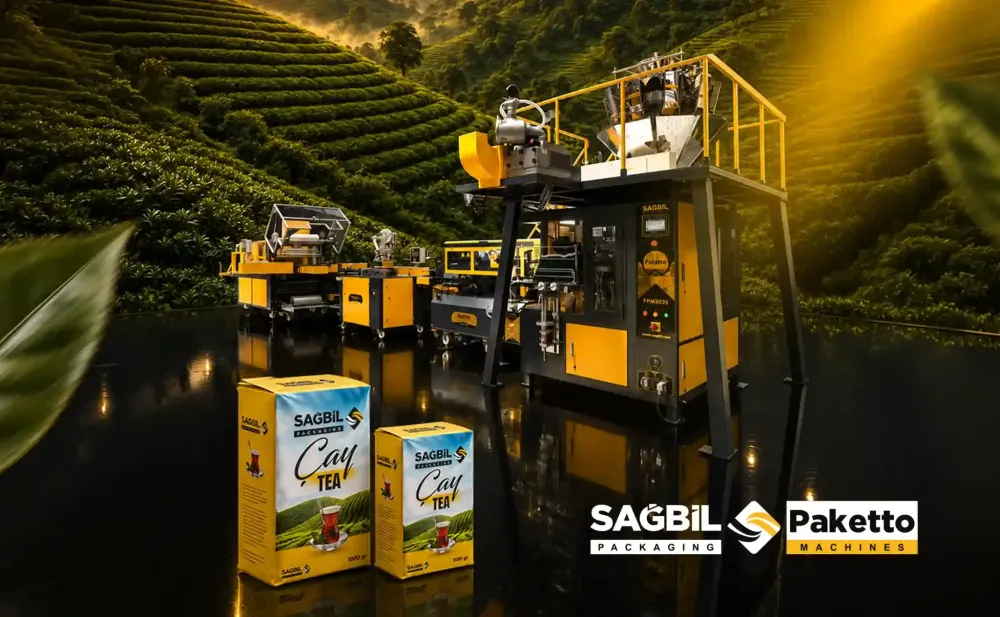
A packaging machine is a type of production equipment used to fill products into packages at predetermined weights, package them, and seal the packaging. Today, packaging machine systems are widely used for the fast and consistent packaging of food products, legumes, tea, flour, spices, and various industrial products. Different types of packaging machines are preferred depending on the characteristics of the product and the type of packaging.
What Does a Packaging Machine Do?
A packaging machine can perform the entire process from product filling to package sealing automatically or semi-automatically. Depending on the characteristics of the product, the packaging machine can operate with different filling systems.
What Are the Main Functions of Packaging Machines?
- Filling the product in predetermined quantities
- Forming the package
- Sealing the package
- Ensuring accurate weight control
- Increasing production speed
- Standardizing the packaging process
Thanks to these features, packaging machines have become an important solution, particularly for businesses engaged in mass production.
What Products Are Packaging Machines Used For?
Packaging machines can be equipped with different systems depending on the physical characteristics of the product. Different filling technologies are used for powder, granular, and particulate products. Therefore, the same packaging machine may not be suitable for every type of product.
What Products Can Be Packaged?
- Legumes
- Flour
- Tea
- Spices
- Sugar
- Salt
- Semolina
- Coffee
- Nuts
- Pet food
When the appropriate packaging machine is selected for the product, filling accuracy and production efficiency can be improved.
How Does a Legume Packaging Machine Work?
A legume packaging machine is used to package products such as lentils, chickpeas, beans, bulgur, and similar granular foods at predetermined weights. Equipped with a filling system suitable for the flow characteristics of the product, these machines enable consistent packaging in mass-production operations.
What Are the Advantages of a Legume Packaging Machine?
- Accurate weighing
- High production capacity
- Compatibility with different package sizes
- Automatic filling and sealing
- More controlled product flow
With these features, legume packaging machines provide an efficient solution for the packaging processes of food manufacturers.
What Products Is a Tea Packaging Machine Used For?
A tea packaging machine is designed to fill and package loose-leaf tea and different varieties of tea in suitable packaging. Systems designed to preserve the characteristics of the tea help ensure that the product is packaged at the specified weight.
What Features Are Important in a Tea Packaging Machine?
- Accurate filling
- Package weight control
- High-speed production
- Compatibility with different packaging options
- Automatic package sealing
The right tea packaging machine should be selected according to the production capacity of the line and the type of packaging being used.
What Is a Food Packaging Machine?
A food packaging machine is a machine system designed to package consumable products hygienically and consistently. Used for products such as legumes, flour, tea, spices, sugar, and similar foods, food packaging machines help make production processes faster and more controlled.
Why Are Food Packaging Machines Preferred?
- They increase production speed.
- They provide consistent package weights.
- They reduce manual operations.
- They streamline the packaging process.
- They can be adapted to different products.
For these reasons, modern packaging machines play an important role in food production facilities.
How Does a Flour Packaging Machine Work?
A flour packaging machine is designed to fill powder products such as flour into packages at predetermined weights. Appropriate filling technology must be used to ensure the controlled transfer of powder products.
What Should Be Considered in a Flour Packaging Machine?
- Accurate weighing
- Dust control
- Filling capacity
- Package dimensions
- Compatibility with production speed
Using a flour packaging machine that matches the facility's production capacity helps ensure a more efficient packaging process.
How Are Packaging Machines Selected?
When selecting packaging machines, the characteristics of the product to be packaged, target package weight, packaging type, and production capacity should first be evaluated. The system used for powder products may differ from the one used for granular products.
What Criteria Should Be Considered When Selecting a Machine?
- Product type
- Product density and flow characteristics
- Package weight
- Packaging format
- Hourly production capacity
- Automation level
- Filling technology
When the right packaging machine is selected according to the requirements of the production line, it can help achieve higher efficiency and more consistent production.
What Is a Vertical Filling Machine?
A vertical filling machine is a system in which the packaging is formed within the machine and the product is filled vertically before the package is sealed. Commonly used for packaging various food products, vertical filling machines are particularly suitable for automated production lines.
What Are the Advantages of Vertical Filling Systems?
- Continuous production
- Fast filling and packaging
- Compatibility with different package weights
- Various packaging options
- Automatic operation
These systems can provide high-capacity solutions for businesses requiring efficient packaging machinery.
What Are the Advantages of Using a Packaging Machine?
A modern packaging machine helps businesses speed up their production processes while ensuring that products are packaged consistently. Automation provides significant advantages, particularly for businesses with high production capacities.
What Are the Advantages of Automatic Packaging?
- Time savings
- More consistent production
- Accurate weighing
- Reduced labor requirements
- Increased production capacity
For these reasons, packaging machines can be used to package a wide range of products, from legumes and flour to tea and spices.