
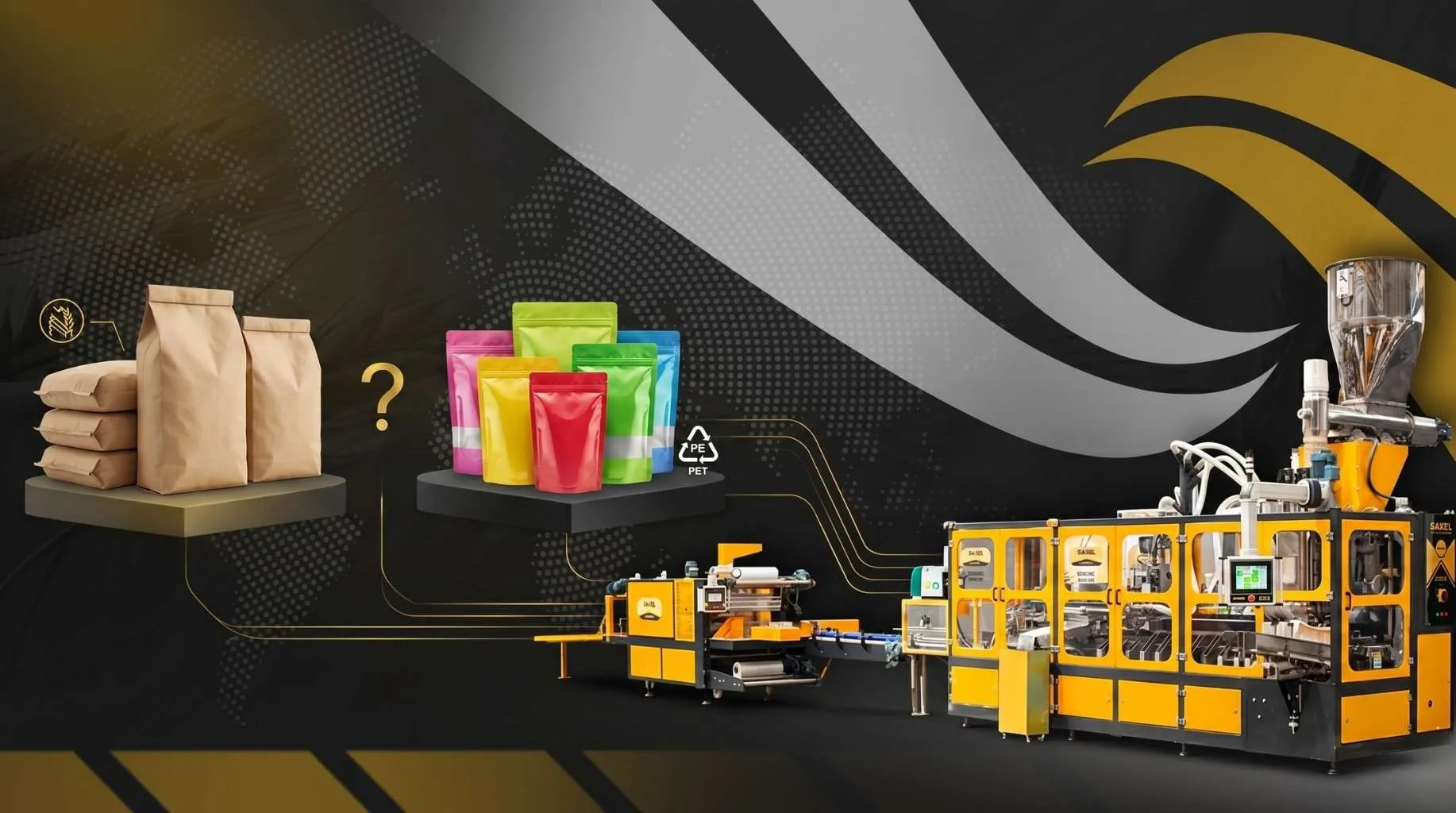
Kraft Bag or Plastic Pouch? The Critical Packaging Choice for Food Manufacturers
One of the most important factors determining profitability and market success in food production is selecting the right packaging. The shelf life of your product, consumer perception, and the operational speed of your production line depend directly on the type of packaging you choose—whether that is a ready-made kraft bag or a plastic-based roll-stock pouch. On one side, you have kraft bags that stand out with their eco-friendly perception and traditional reliability; on the other, you have Vertical Form Fill Seal (VFFS) systems, the champions of hermetic sealing and high-speed production.
At Sagbil Packaging Machines, with the expertise of establishing over 1,000 global production lines, we offer food manufacturers solutions that set industry standards for both technologies. So, which is the most profitable and accurate investment for your product?
1. Production Speed and Efficiency (The Power of VFFS Pouches)
If your goal is to reach maximum production capacity and save on logistics footprint, Vertical Form Fill Seal (VFFS) machines are the undisputed leaders. These advanced packaging lines transform roll-stock film into perfect pillow, block-bottom, or gusset bags in seconds.
For instance, our Sagbil PAKETTO 9000 series operates at high speeds up to 70 packs per minute, enabling your facility to break production records. Especially for packaging products like pulses, nuts, tea, and granulated sugar in consumer weights from 250g to 1kg, vertical multi-head weighers or volumetric systems offer the highest operational efficiency.
2. Product Protection and Shelf Aesthetics (The Prestige of Kraft Bags)
Paper Bag Filling and Packaging Machine; With rising environmental awareness, paper (kraft) bags broadcast a message of "naturalness and quality" to the consumer. Particularly for products with high dusting risks between 1 kg and 10 kg, such as flour, semolina, and starch, kraft bags are preferred for their upright shelf stance and breathable structure.
Sagbil Paper Bag Filling Lines (such as the Paketto 8070LDS Linear Automatic Series) fill flat-bottom ready-made paper bags with ±1% precision, preserving the natural texture of flour or semolina while creating shelf-ready, aesthetic packages.
Industry Forum Debate: "The Seal Integrity Crisis with Dusty Products"
The most fervently discussed topic among food engineers and packaging experts on sectoral forums is: "When packaging very fine-grained products like flour, milk powder, or coffee at high speeds, intense dusting occurs at the mouth of the package. When using pouches (plastic), the heat jaws fail to weld (seal) completely because of this dust. When using kraft bags, the hotmelt glue does not adhere fully. How do we overcome the problem of bursting packages?"
Regardless of the packaging type, this crisis is fundamentally about the machine's dust extraction capability.
The Sagbil Engineering Solution: Whether you use a Vertical Form Fill Seal line or a paper bag filling machine, Sagbil systems eradicate the problem at the source. In both lines, we integrate powerful vacuum units to capture dust at the source during the filling of powdery products. Our Vertical Auger Filler technology prevents dusting, ensuring the package opening remains pristine. Consequently, on VFFS pouch lines, the heat jaws execute a 100% hermetic seal, while on kraft bags, the bag clipping machines or folding units close flawlessly.
Which Packaging Machine Suits You?
Shape your investment decision based on your product's physical structure and market target:
-
High Speed and Low Material Cost: Sagbil PAKETTO 9000 VFFS vertical filling series utilizing roll-stock film (ideal for pulses, tea, coffee).
-
Premium Look and Eco-Friendly Image: Sagbil Paketto 5050K and 8070LDS Paper Bag Filling lines using flat-bottom ready-made bags (ideal for flour, semolina, organic products).
For more content, please visit our Sağbil News page.
For more information about our company, please visit our contact information.
People Also Ask (PAA)
What is the price difference between a paper filling machine and a VFFS machine?
Prices vary based on targeted capacity (hourly production), automation level, and integrated weighing technologies (weigher, auger). Because VFFS machines create their own packaging from roll film and generally operate at higher speeds, the per-unit packaging cost is significantly lower.
Can both plastic pouches and kraft bags be used on the exact same packaging machine?
No. Vertical Form Fill Seal (VFFS) machines construct plastic bags out of a flat roll of film, whereas Paper Bag Filling Lines utilize pre-manufactured, flat-bottom kraft bags. Both technologies possess entirely distinct mechanical infrastructures.
Is a kraft bag or a transparent plastic pouch better for pulses?
Consumers generally want to inspect the physical condition (check for broken grains) of pulse products like lentils and rice before purchasing. Therefore, for pulse packaging, VFFS lines equipped with Multi-Head Weighers using transparent or windowed plastic pouches are the undisputed industry standard.
Frequently Asked Questions (FAQ)
1. What technologies do you use for sealing kraft bags?
Depending on your production speed and bag size in our paper bag filling lines, we utilize hotmelt folding systems or, especially for heavy bags, integrated belt stitching machines.
2. How much product giveaway occurs with your VFFS pouch machines?
Thanks to our integrated Vertical Weigher (10TD, 14TD), Vertical Auger (VD), or Volumetric filling systems, the grammage precision of the packaged product is ±1%. In industrial terms, this equates to absolute zero product giveaway.
3. What are the food safety standards of your machines?
Whether it is a paper filling line or a VFFS line, all surfaces in contact with the product are manufactured from AISI 304 grade stainless steel, fully compliant with international food norms, and feature a modular design for easy cleaning.